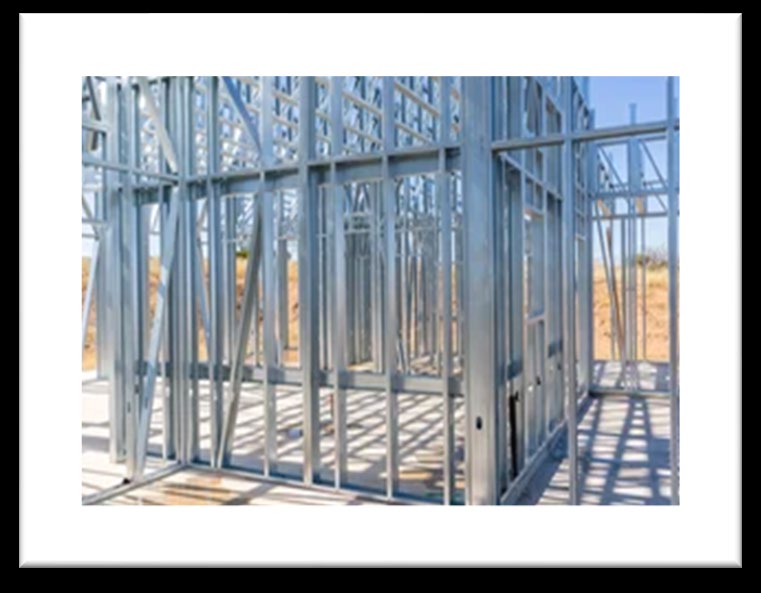
The claim that light gauge steel builds faster is repeated so often that it has stopped meaning very much. It is true, but the reason is frequently misunderstood — and that misunderstanding leads people to expect savings in the wrong place.
The time is saved before anyone reaches site
Conventional framing is made on site. Members are measured, cut and fixed in position, which means the programme absorbs every delay: weather, labour availability, rework from measurement error.
Light gauge steel inverts this. Members are rolled to precise dimensions in a controlled environment, pre-punched for services, and labelled for assembly. What arrives on site is closer to a kit than a pile of raw material.
The consequence is that site time becomes assembly time, which is far more predictable than fabrication time. That predictability is worth as much as the raw speed.
Where the programme actually compresses
- Fabrication runs parallel to groundworks. Frames are produced while foundations are still being poured, rather than after.
- Rework largely disappears. Components are dimensionally consistent, so the tolerance-chasing that consumes conventional builds does not arise.
- Weather matters less. A steel frame goes up in conditions that would halt blockwork entirely.
- Follow-on trades start sooner. Services routes are pre-punched, so first fix does not wait on drilling.
Being honest about the trade-offs
Design has to be resolved earlier. Because members are manufactured to a specific design, late changes are expensive in a way they are not with conventional framing — you cannot simply cut a new opening on site without engineering input.
That front-loading is the real cost. Teams accustomed to resolving details as they go sometimes find it uncomfortable. But the discipline it imposes is precisely what produces the programme certainty.
Is it right for your project?
Light gauge steel suits repetitive layouts, tight programmes and difficult sites. It is less compelling for small one-off builds where design is still fluid.
If you are weighing it against conventional construction, the useful comparison is not cost per square metre but total programme cost — including the financing and overhead that a shorter build avoids.