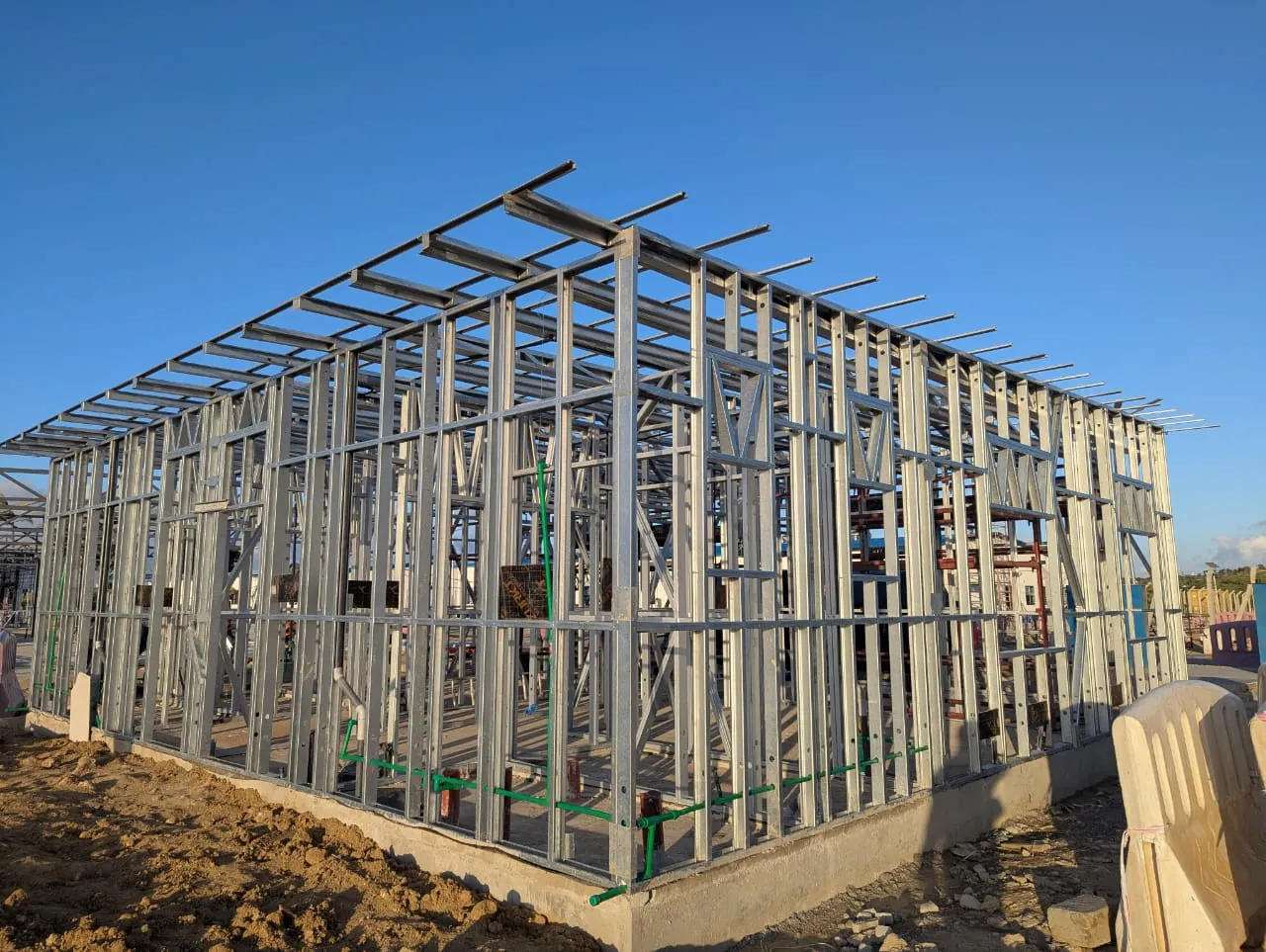
Modular construction in Kenya is usually sold as a shortcut. It is not one. It is a different sequence — most of the building is made to a fixed dimension before anyone reaches site, and site work becomes assembly rather than fabrication.
That distinction is what lets a client be given a programme and a price that both hold. Here is what the method involves, and how Pavilion Master Builders delivers it as one turnkey package rather than a chain of separate trades.
What modular construction actually means
Conventional wet construction makes the building on site. Blocks are laid, mortar cures, plaster goes on wet and must dry before the next trade starts. Every one of those steps depends on weather, and each absorbs its own delay.
Dry, modular construction inverts it. Components are produced to dimension off site, delivered in sequence, and fixed rather than cast. Waste drops because material is cut to a list, and quality control moves somewhere it can be measured.
The commercial consequence matters more than the technical one. When fabrication is controlled, cost becomes predictable — variation comes from design change, not from what the site did that week.
Light gauge steel construction in Kenya
The structural system is light gauge steel framing: cold-formed sections rolled to a specific design, pre-punched for services and labelled for assembly.
For a specifier the attraction is dimensional consistency. Members arrive at the designed length, so the tolerance-chasing that consumes conventional framing does not arise and follow-on trades inherit a square frame. Service routes are already punched, so first fix does not wait on drilling.
Sections are specified against the loading and spans of each project rather than taken from a standard catalogue.
The trade-off is front-loaded design: because members are manufactured to a resolved drawing, late changes carry engineering cost in a way they do not with in-situ framing. That discipline is what produces the programme certainty.
Fiber cement cladding and the dry envelope
The envelope follows the same logic. Fiber cement boards fix directly to the steel frame, so the building is closed without curing time and without a wet trade sitting on the critical path.
The material resists fire, termites and weather, removing several of the failure modes that shorten a façade’s life on humid or coastal sites. Boards are cut to size and fixed at set centres, so the envelope goes on at a predictable rate.
Because frame and board are both dimensionally stable, junctions can be detailed rather than made good on site. That is where dry construction earns its durability — in the interfaces being designed before anyone builds them.
Roofing and finishes, in plain terms
Roofing is where most owners’ questions start. Decra stone coated roofing tiles are steel tiles with a stone chip surface, and the roof we fit most often in Kenya.
The appeal is simple. They are light, so they suit a steel frame and do not load the structure. They are weatherproof. And they are built to last fifty years and more.
Inside, Mixx decorative micro-cement gives walls and floors a smooth, seamless finish with no tiles and no grout lines. It goes over the same fiber cement boards used elsewhere, so a wall can be framed, clad and finished without switching system. Nothing to re-grout, nothing to work loose.
A turnkey construction contractor in Nairobi
Most of the risk in a modular build sits in the joins — between frame supplier, cladding installer and roofer, each warranting their own part and none owning the interface where the three meet.
Pavilion supplies and installs the whole of it: design, framing, cladding, roofing and finishes, under one contract from our Nairobi office. The team that details the frame details the envelope that lands on it.
It is the same method behind our alternative and eco-build work — homes, schools, hotels and hospitals delivered with off-site fabrication as the norm rather than as a one-off experiment.
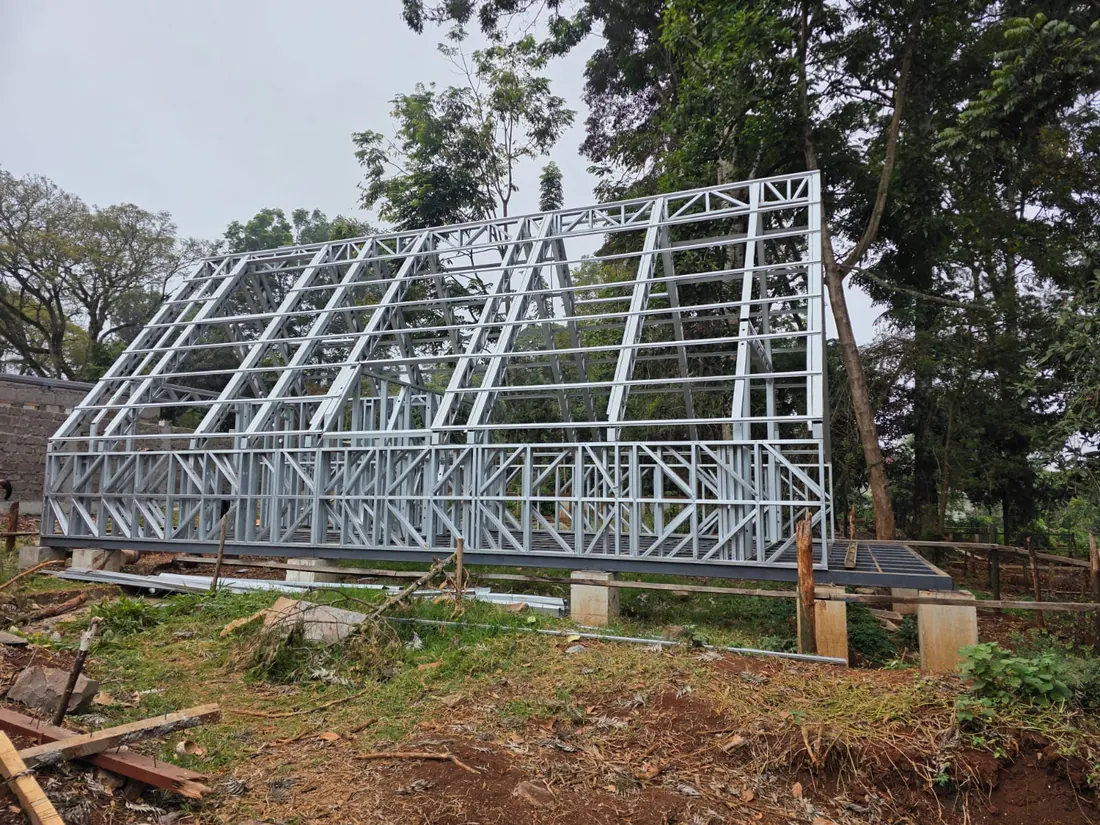
The A-frame structures above are the same system in a different geometry — a shape that is slow and wasteful in blockwork, and is not once framing is manufactured rather than cut on site.
Getting a modular build priced
If you are weighing modular construction in Kenya against a conventional build, the useful comparison is not cost per square metre. It is total programme cost, including the financing and preliminaries that a shorter build never incurs.
Tell us the site, the brief and the programme, and we will price the whole thing — frame, envelope, roof and finishes — as a single turnkey package. Talk to our team in Nairobi for a modular construction quote.